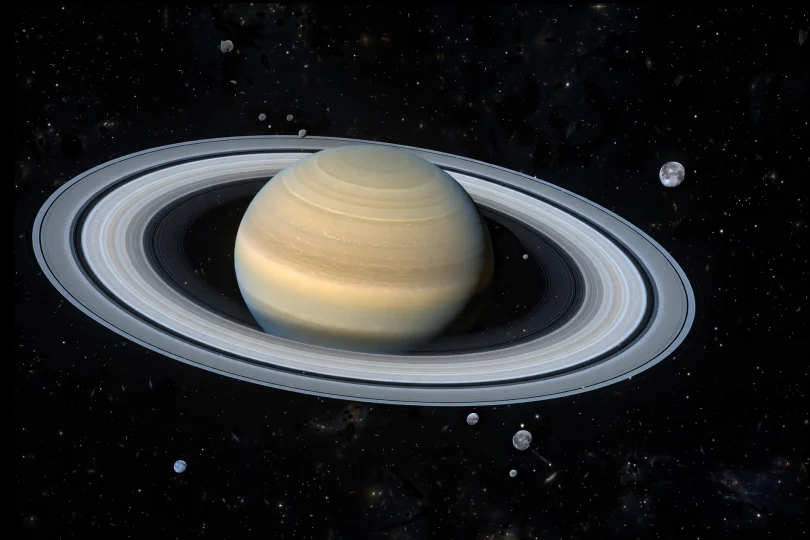

If you keep a notebook of sky facts by your keyboard, it is time to cross one out. Saturn does not have 146 moons any more; it has 274. Astronomers have confirmed 128 new moons in a single recognition, the result of years of deep imaging rather than a single dramatic night, and the new total is larger than the moon counts of all other planets combined. For the bloggingnights.com audience, this is a perfect late-night read: a famous planet, a patient method, and a swarm of tiny worlds that nobody had counted before.
A Story Worth Staying Up For
Late-night writing often starts with a single startling number, and 274 is certainly one of them. Astronomers have confirmed 128 additional moons around Saturn, lifting the planet from 146 to 274 in total, more than every other planet combined can claim. For bloggers, the lesson is in the telling as much as the tally. This was not a sudden appearance in the sky. It was the end of years of patient observing, checking and rechecking, finally recognised by the International Astronomical Union. If you enjoyed our piece on what Microsoft’s AI warning means for bloggers, you will appreciate how a careful headline can inform readers without exaggerating a genuinely remarkable result.
The Patient Craft Behind the Headline
Good posts and good astronomy share a habit: neither trusts a first draft. The team used the Canada-France-Hawaii Telescope on Mauna Kea to collect deep images across several years. They then applied shift and stack, moving each image to match a moon’s expected motion and layering them so faint objects grew visible while stars trailed away. Candidates were watched again until their orbits were secure. Dr Edward Ashton, a researcher at the University of British Columbia involved in the work, has emphasised that sustained follow-up is what separates a confirmed moon from a passing speck that merely looked promising on one night.
Small Moons With Untidy Habits
Do not picture 128 new versions of our own Moon. These bodies are only a few kilometres wide, distant from Saturn, and set on tilted, looping routes. A good number travel retrograde, circling against the direction of the planet’s spin. Writers looking for a metaphor could call them footnotes rather than chapters, yet footnotes change how a text reads. Scientists believe many are shards of larger captured moons, broken by collisions long after they were pulled into Saturn’s gravity. Their shared orbital families support that reading, and the Canada-France-Hawaii Telescope survey gave researchers enough examples to compare those families properly.
Why Readers Keep Coming Back to Saturn
Saturn has always been the planet people remember from school posters, largely because of its rings. This discovery gives editors and creators a fresher angle: the most visually famous planet is also, by a wide margin, the most accompanied. That contrast, beauty up close and chaos far out, is exactly the kind of tension that makes science writing work. Our creative piece on mapping archetypes for writers explored how patterns help stories stick; here the pattern is physical. Captured objects, violent breakups and slow gravitational sorting produced the swarm we can now, finally, count with some confidence.
Notes for Your Next Science Post
If you write about this discovery, keep three anchors in the copy: the telescope, the technique and the recognition process. Those details protect a post from drifting into hype. Say clearly that the moons are tiny and irregular, that detection took years, and that work on their orbits continues. Saturn may well gain more moons as instruments improve, because the current survey shows how many objects sit just below older detection limits. For tonight, though, the verified figure is 274, and that is plenty. A planet once known mainly for its rings now holds a record no rival is likely to challenge soon.
One More Point of Context
Editors planning follow-up coverage should note that the discovery also changes the visual language of the solar system. Diagrams that once showed Saturn with a modest retinue now need a distant cloud of irregular companions to be accurate. That cloud is not decorative. Each point in it represents an object with a measured orbit, a capture or collision history, and a contribution to understanding how giant planets interacted with the material around them as the solar system settled into its present form over billions of years.